
FATF Grey List 2026: A Growing Compliance Imperative for Financial Institutions
Table of content
- Introduction
- Kuwait FATF Grey List 2026: Compliance Framework Exists, But Effectiveness Needs Strengthening
- Papua New Guinea FATF Grey List 2026: Strengthening Supervisory and Monitoring Frameworks
- Why Asian Countries Continue to Appear on the FATF Grey List
- African Grey-listed Countries: Progress Made, But Effectiveness Gaps Remain
- The Top 3 Reasons Countries Are Grey-listed — and How Financial Institutions Are Expected to Respond
- How Profinch and Oracle FCCM Help Financial Institutions Address FATF Grey-listing Risks
- Conclusion: FATF Grey-listing Is a Catalyst for AML Transformation
Introduction
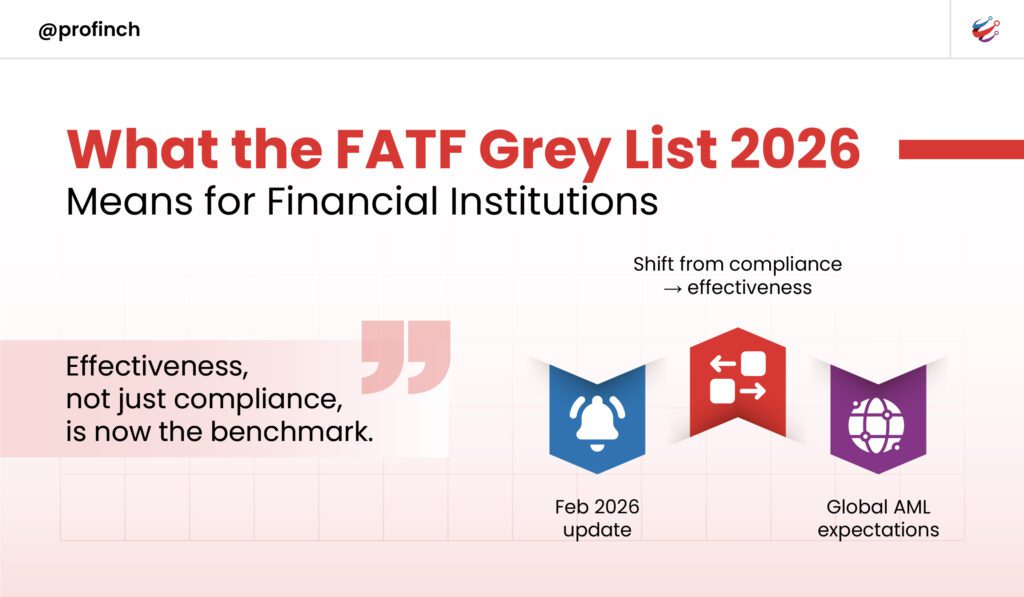
In February 2026, the Financial Action Task Force (FATF) announced its latest update to the list of jurisdictions under increased monitoring—commonly known as the FATF grey list. The addition of Kuwait and Papua New Guinea highlights ongoing global efforts to strengthen Anti-Money Laundering (AML), Counter-Terrorist Financing (CFT), and financial transparency frameworks.
Financial institutions and the countries are no longer evaluated solely on regulatory compliance—but on the effectiveness of their AML programs.
Kuwait FATF Grey List 2026: Compliance Framework Exists, But Effectiveness Needs Strengthening
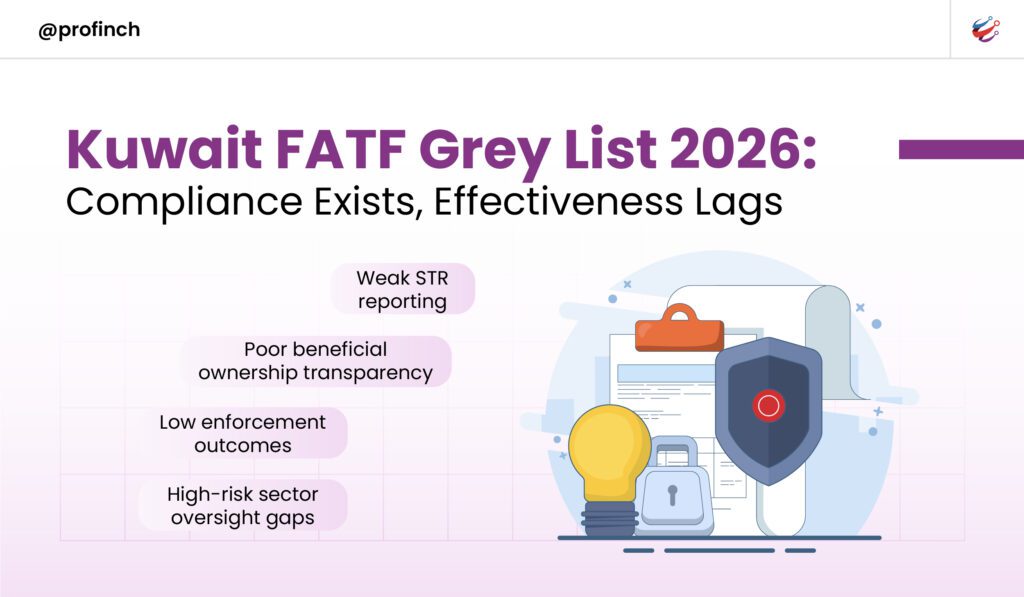
Kuwait’s inclusion in the FATF grey list reflects gaps in operational effectiveness rather than absence of regulatory frameworks. FATF identified areas requiring improvement, including:
- Strengthening suspicious transaction reporting, particularly in non-bank financial sectors / DNFBPs.
- Improving beneficial ownership transparency,
- Increasing money laundering investigations and enforcement outcomes,
- Enhancing oversight of high-risk sectors such as real estate and precious metals.
Kuwait’s financial sector is mature and regionally connected, but FATF now expects demonstrable outcomes—stronger detection, intelligence utilization, and enforcement support.
This signals increased compliance expectations for banks, exchange houses, and financial service providers operating in Kuwait.
Papua New Guinea FATF Grey List 2026: Strengthening Supervisory and Monitoring Frameworks
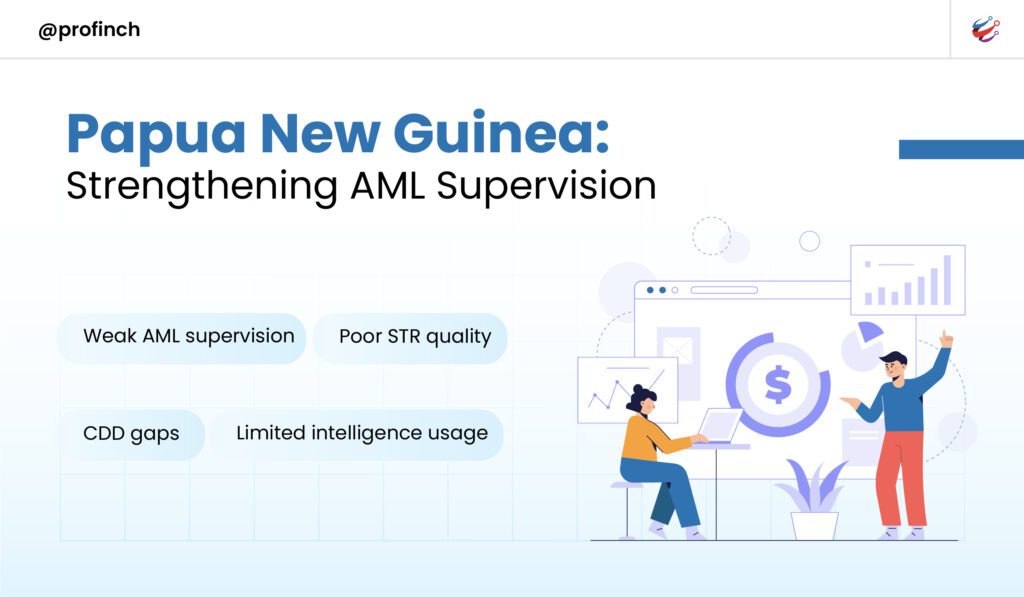
Papua New Guinea was grey-listed due to structural weaknesses in AML supervision, financial intelligence utilization, and beneficial ownership transparency.
FATF identified the need to:
- Improve risk-based AML supervision,
- Strengthen customer due diligence and ownership transparency,
- Enhance suspicious transaction reporting effectiveness,
- Improve financial intelligence analysis and investigation support.
As Papua New Guinea strengthens its financial system and cross-border connectivity, institutions must now demonstrate stronger AML controls and monitoring capabilities.
Why Asian Countries Continue to Appear on the FATF Grey List
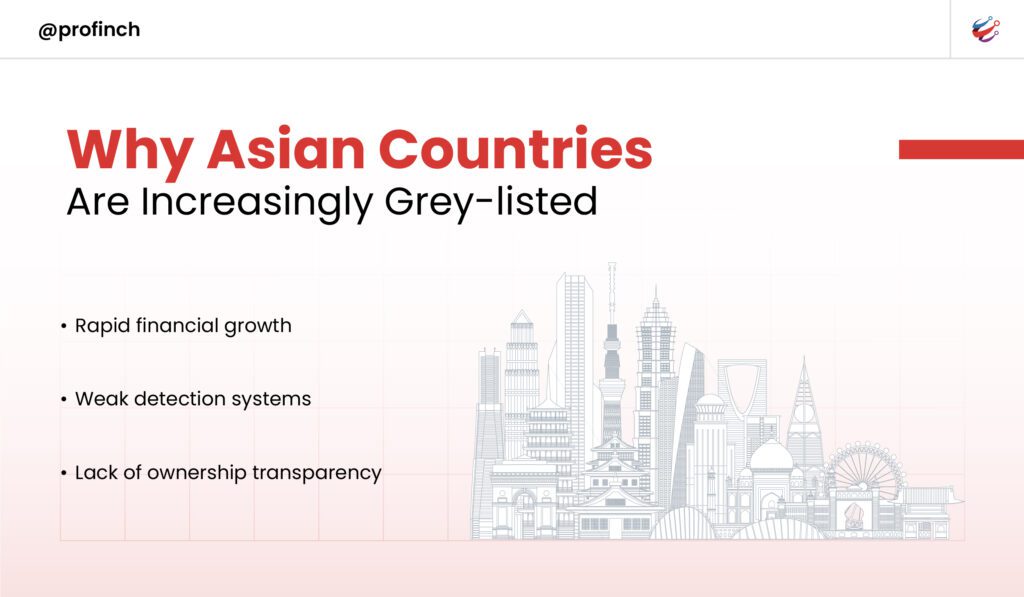
The addition of Kuwait and Papua New Guinea follows previous grey-listing of Laos and Nepal, reflecting broader regional trends. The count of the Asian countries are getting grey-list is steadily increasing from last couple of years.
Three structural factors explain why growing Asian economies are increasingly under FATF scrutiny:
- Rapid Financial Sector Growth and Cross-Border Exposure
Financial systems across Asia are expanding rapidly through:
- Digital banking,
- Cross-border remittances,
- Trade finance,
- Fintech adoption.
Compliance infrastructure often struggles to scale at the same pace, creating gaps in monitoring and risk visibility.
- Insufficient Suspicious Transaction Detection and Reporting Effectiveness
Many jurisdictions have regulatory requirements in place, but financial institutions often face challenges in:
- Detecting complex money laundering patterns,
- Generating high-quality suspicious transaction reports,
- Linking suspicious activity across multiple systems.
This limits financial intelligence effectiveness.
- Limited Beneficial Ownership Transparency
Opaque ownership structures prevent institutions from identifying ultimate beneficial owners and assessing true customer risk exposure.
This remains one of the most common FATF evaluation gaps globally.
African Grey-listed Countries: Progress Made, But Effectiveness Gaps Remain
Several African countries remain on the FATF grey list, including Kenya, Namibia, Cameroon, South Sudan, and the Democratic Republic of Congo.
These jurisdictions have made regulatory improvements but continue to face challenges in three key areas:
- Improving suspicious transaction reporting quality and consistency,
- Strengthening beneficial ownership transparency,
- Increasing money laundering investigation and prosecution effectiveness.
The challenge is no longer regulatory framework adoption—but operational effectiveness. Financial institutions must demonstrate measurable compliance outcomes supported by robust AML technology infrastructure.
The Top 3 Reasons Countries Are Grey-listed — and How Financial Institutions Are Expected to Respond
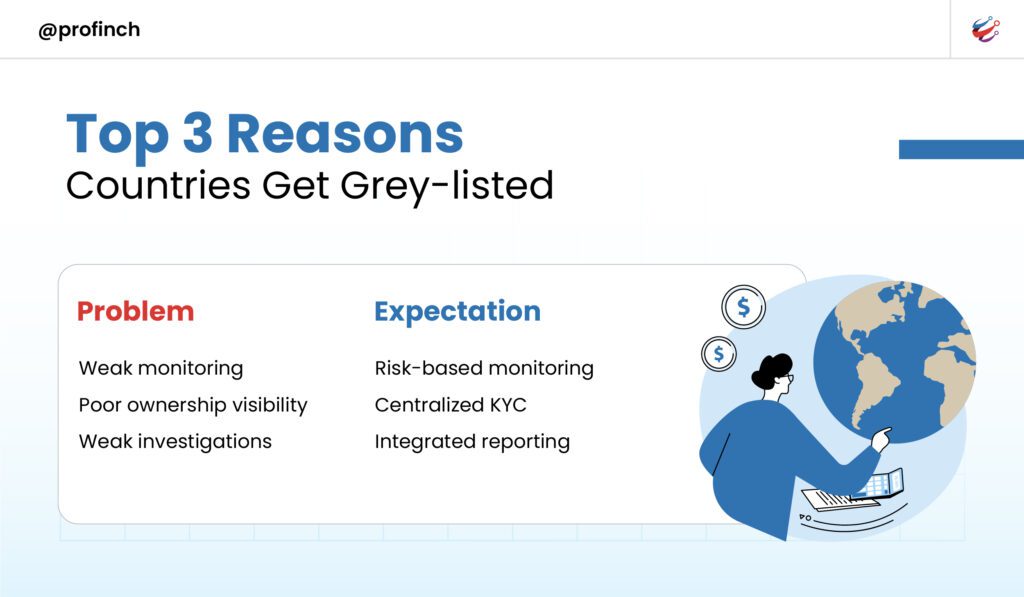
There are around 22 countries put under grey list. Based on FATF findings across Asia, Africa, and emerging markets, three core deficiencies consistently lead to grey listing:
Reason 1: Weak Transaction Monitoring and Suspicious Activity Detection
Institutions lack advanced monitoring capabilities to identify sophisticated financial crime patterns.
Institutional Requirement: Implement risk-based transaction monitoring aligned with FATF typologies.
Reason 2: Poor Customer Risk Visibility and Beneficial Ownership Tracking
Institutions struggle to identify ultimate beneficial owners and maintain accurate customer risk profiles.
Institutional Requirement: Implement centralized customer risk management and beneficial ownership visibility.
Reason 3: Limited Investigation Capability and Regulatory Reporting Effectiveness
Even when suspicious transactions are detected, investigation workflows and regulatory reporting are often inefficient.
Institutional Requirement: Implement integrated AML investigation and regulatory reporting systems.
How Profinch and Oracle FCCM Help Financial Institutions Address FATF Grey-listing Risks
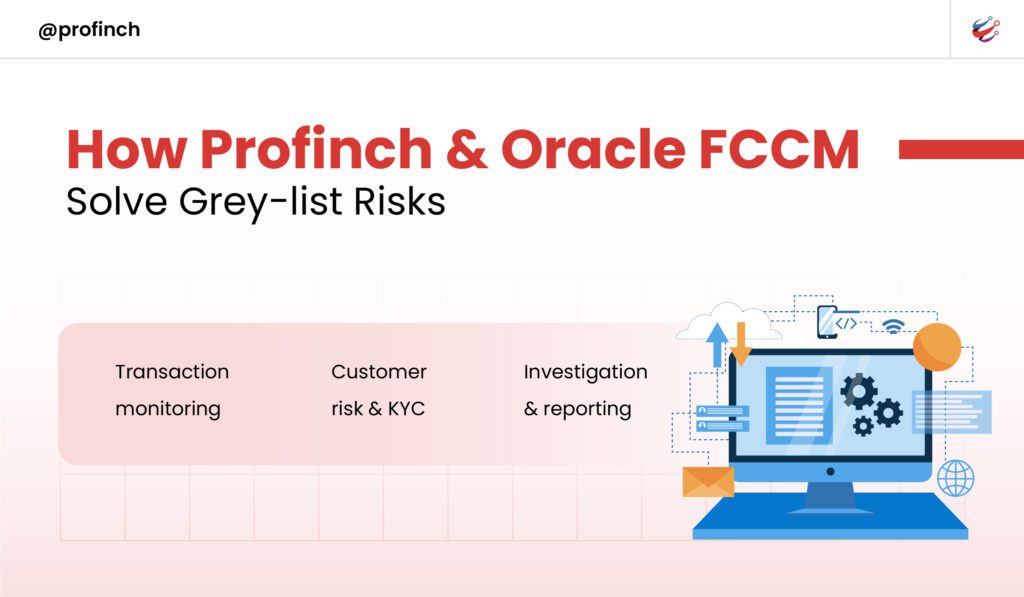
Oracle Financial Crime and Compliance Management (FCCM) provides an integrated AML platform designed to address the exact deficiencies FATF identifies. Profinch, as a specialist Oracle FCCM implementation partner, helps financial institutions implement and optimize AML technology aligned to FATF expectations. For institutions operating in grey‑listed jurisdictions, Profinch and Oracle FCCM can directly target these three weak points by helping banks and FIs evidence a truly risk‑based AML regime, not just policy documents.
By using Oracle FCCM’s risk scoring and transaction monitoring capabilities, Profinch can work with institutions to embed jurisdiction‑specific ML/TF typologies (for example, cross‑border cash movements, trade‑based patterns, high‑risk DNFBP exposure) into scenarios, calibrate thresholds to local and FATF‑highlighted risks, and generate management information that supervisors can map back to the country’s RBA and FATF action‑plan milestones.
On the transparency side, Profinch can design and implement Oracle FCCM‑based KYC and customer‑risk‑rating workflows that capture beneficial ownership down to natural persons, integrate external registries and corporate data sources where available, and enforce periodic reviews so that institutions can demonstrate to regulators that BO information is complete, verified, and actively used for risk decisions rather than a static data field.
For enforcement and sanctions effectiveness, institutions can leverage Oracle FCCM’s case management, alert investigation and sanctions‑screening capabilities to build an auditable end‑to‑end trail from detection through STR filing, while Profinch supports them in defining typology‑driven investigative playbooks, mapping KPIs (e.g., complex case volumes, STR conversion rates, turnaround times) to FATF expectations, and configuring governance dashboards that give boards and supervisors concrete evidence of progress without over‑promising outcomes such as automatic de‑listing.
Why Profinch Is the Trusted Oracle FCCM Partner for Grey-listed Jurisdictions
Profinch specializes in implementing Oracle FCCM for financial institutions across emerging markets, helping institutions align AML programs with FATF expectations.
Profinch brings:
- Deep Oracle FCCM implementation expertise,
- Strong understanding of FATF and regulatory expectations,
- Experience working with banks in developing and greylisted jurisdictions,
- Proven methodologies for improving AML effectiveness.
Why Financial Institutions Must Act Now
Grey-listing increases scrutiny across the financial ecosystem, including:
- Correspondent banking relationships,
- Regulatory examinations,
- AML audits,
- Cross-border transaction monitoring expectations.
Institutions that proactively strengthen AML capabilities position themselves to maintain correspondent relationships, meet regulatory expectations, and support national compliance efforts.
Conclusion: FATF Grey-listing Is a Catalyst for AML Transformation

The addition of Kuwait and Papua New Guinea to the FATF grey list reinforces a global shift toward outcome-driven AML compliance.
Financial institutions must strengthen transaction monitoring, customer risk management, and investigation capabilities.
With Oracle FCCM and Profinch’s implementation expertise, institutions can build AML frameworks aligned with FATF expectations and global best practices.

Speak to us to understand how our consulting solutions and products are shaping the future of BFSI.