
Islamic Banking at Scale: Why the Product Is the Easy Part
Table of content
- The next test isn’t product creation. It’s operation.
- Growth multiplies more than volume
- Islamic banking has a different lifecycle equation
- The machinery behind a single product
- Configuration creates products. Lifecycle management creates scale.
- Shariah governance is moving into the operating architecture
- Standardise the machinery, localise the rules
- Regulatory reporting and profitability: the missing visibility layer
- What Islamic banking technology architecture needs to do differently
- The executive question is changing
- Conclusion: the lifecycle is where the promise is kept
Introduction
As regulators move Shariah governance from the committee room into the core banking system, the question facing Islamic banks is shifting from whether a product can be launched to whether its full lifecycle can be run, evidenced and changed at scale.
The next test isn't product creation. It's operation.
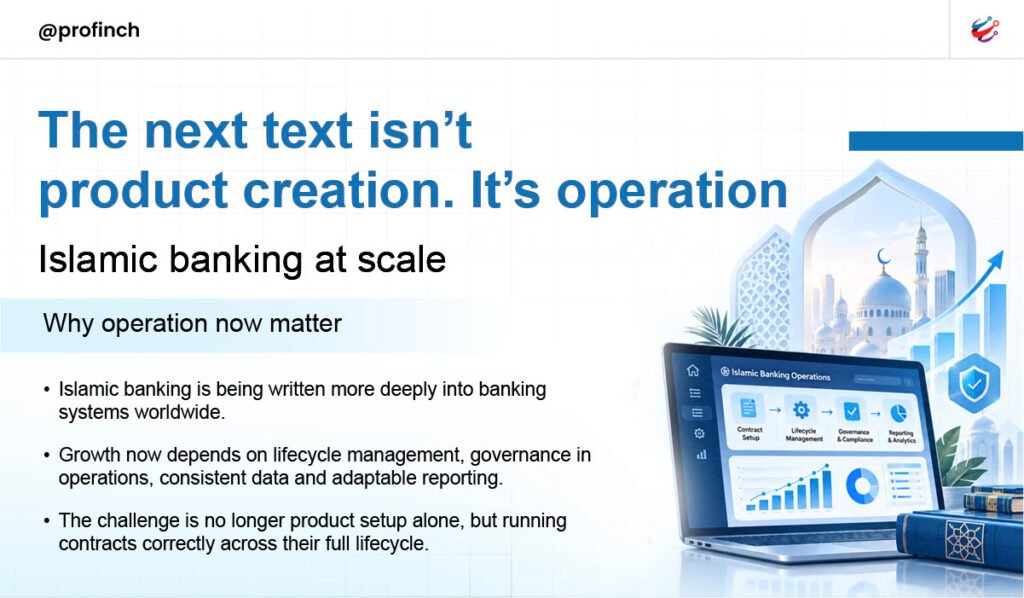
Islamic banking is being written into more of the world’s banking systems, and more deeply. In 2026 alone, Uzbekistan’s first Islamic finance law came into force, requiring institutions to establish their own Shariah councils under standards approved by the central bank1, and Kazakhstan’s new banking law opened the way for universal banks to run Islamic windows with organisational and accounting segregation2. In the UAE, a 2025 decree-law made the Higher Sharia Authority’s determinations binding not only on internal Shariah committees but on Islamic financial institutions themselves3. Pakistan has gone furthest, writing a 1 January 2028 deadline for eliminating riba into its constitution4; Islamic banking already held 22.9% of the country’s banking assets at the end of 20255.
The industry is now large enough for operational failure to be a supervisory concern. The Islamic Financial Services Board (IFSB) puts global Islamic financial services assets at approximately USD 4.4 trillion in 2025, with banking accounting for nearly 70%. In 16 jurisdictions, Islamic banking exceeds 15% of domestic banking assets, the IFSB’s threshold for systemic significance, and those markets hold 93% of global Islamic banking assets6.
What connects these developments is a shift in where the hard problem in Islamic banking technology sits. Configuring a Murabaha facility or a Mudarabah savings account on a modern core banking platform is, for the most part, solved. What is not solved at scale is running tens of thousands of such contracts through their full lifecycle (asset purchase, sale, payment events, profit calculation, pool accounting, distribution and disclosure) across jurisdictions whose rules differ, with evidence that every step happened in the right order. When the IFSB surveyed 80 Islamic banks across 21 jurisdictions, 74% said legacy infrastructure impeded their response to changing market dynamics7.
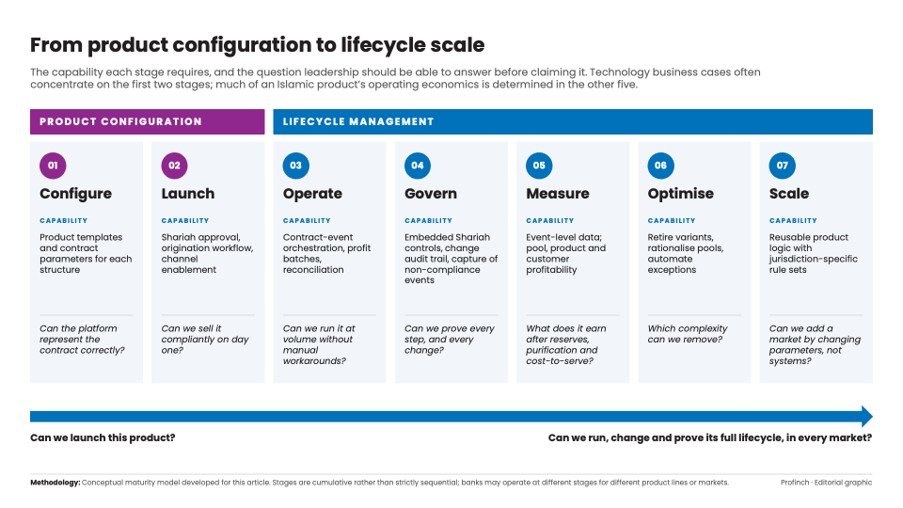
The argument of this article is simple. Product configuration enables Islamic banking growth. Whether that growth can scale depends on lifecycle management, governance embedded in operations, consistent data and adaptable reporting.
Growth multiplies more than volume
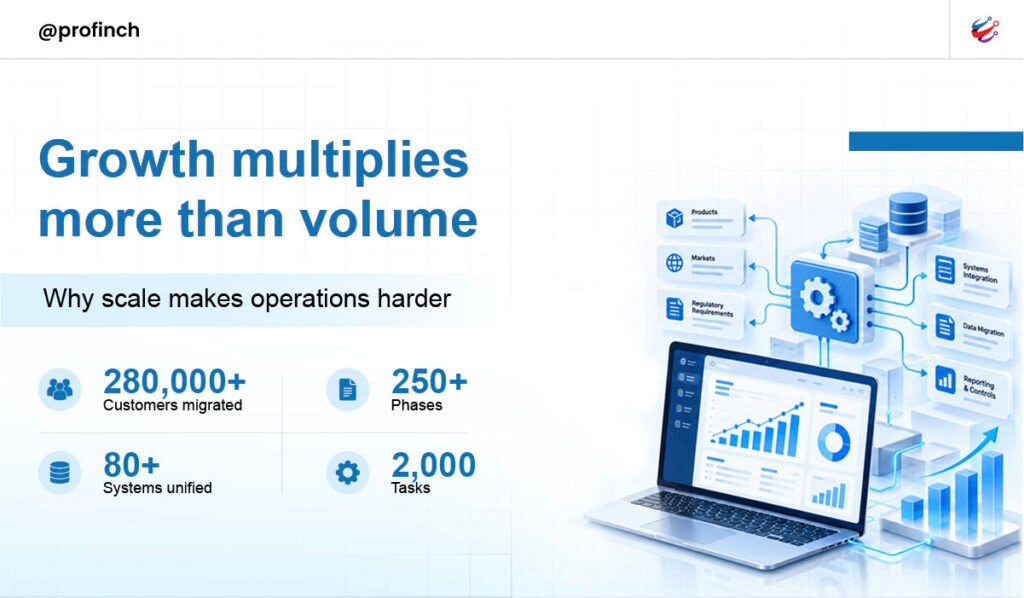
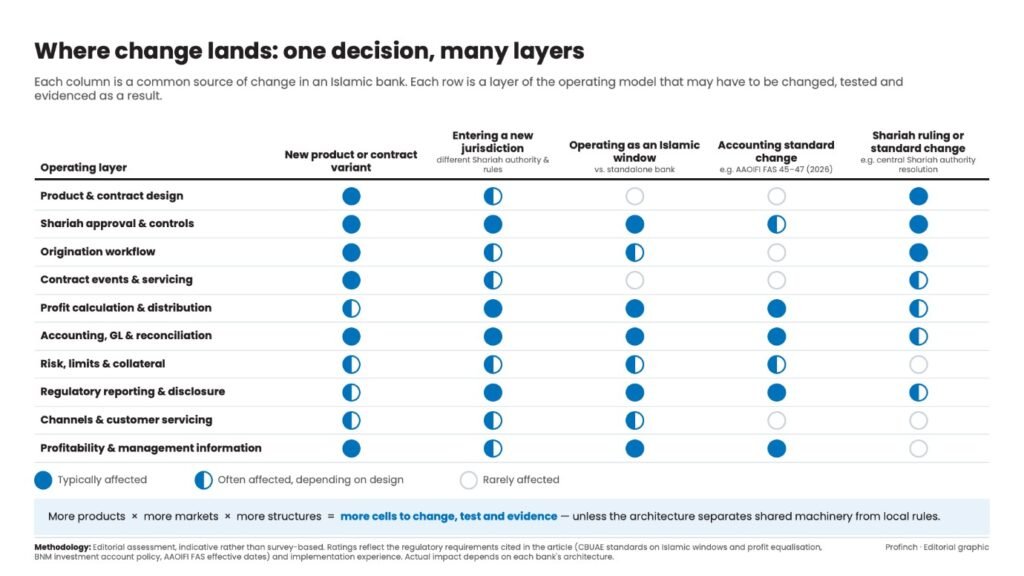
In conventional banking, growth mostly multiplies volume. In Islamic banking it also multiplies the number of places where a Shariah requirement must be honoured and then proven. Every new product brings a contract structure with its own sequencing rules. Every new market brings its own Shariah authority, accounting basis and disclosure regime. Every Islamic window brings segregation obligations that run from product codes through the general ledger to regulatory returns.
The cost of this becomes visible when institutions convert or combine. Kuwait Finance House’s 2024 annual report describes bringing the former Ahli United Bank into its Shariah-compliant model: migrating the accounts and products of more than 280,000 customers and unifying more than 80 systems, across more than 250 phases and 2,000 tasks8. System-wide conversion programmes, such as Pakistan’s, pose the same engineering problem at national scale. Implementation experience shows the same breadth without a merger: one Gulf Islamic bank’s transaction banking programme spanned core processing, payments, Islamic trade finance, limits and collateral, and corporate digital banking, each of which had to recognise the same Islamic structures.
For a COO, the cost of a product is not fixed at launch. It is set by how many downstream processes must vary to support it, and how many of those variations must be evidenced to a Shariah committee and a supervisor.
Islamic banking has a different lifecycle equation
Two features make the Islamic lifecycle structurally different, not just longer.
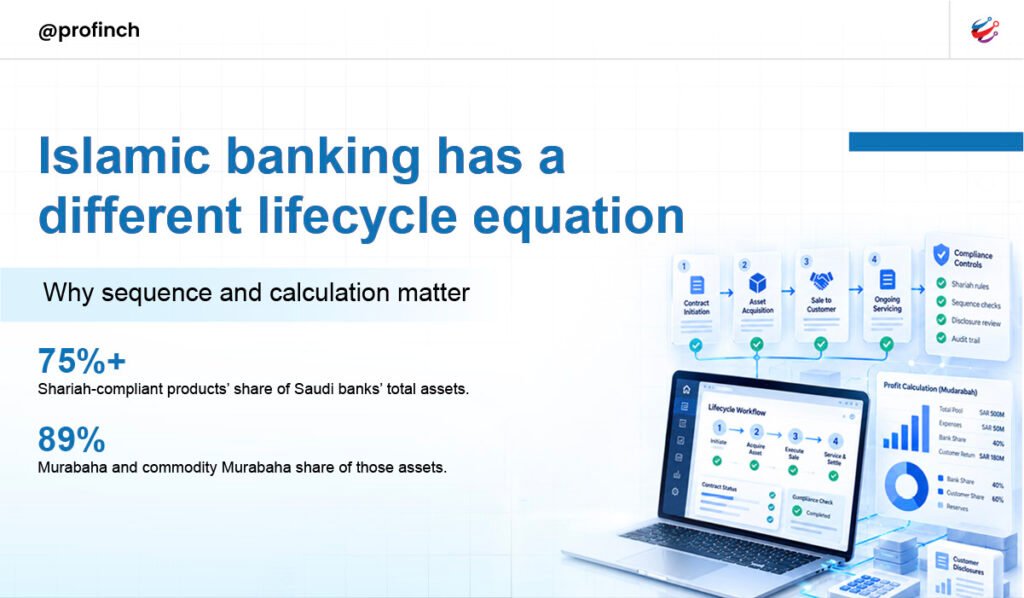
First, sequence is a compliance fact. In a Murabaha, the bank must own the asset before it sells it to the customer. IFSB research states plainly that “omission or wrong sequencing of any of the steps involved renders the transaction Sharīʿah non-compliant”7. A survey of Malaysian Islamic banks found that improper sequencing, where the asset is sold to the customer before the bank has bought it, was the most frequent Shariah non-compliance event in tawarruq financing, a commodity Murabaha-based structure9. In conventional lending, a workflow executed out of order is an efficiency problem. In Islamic financing, it can mean the income cannot be recognised.
The IMF’s 2024 financial sector assessment of Saudi Arabia found that Shariah-compliant products make up over 75% of banks’ total assets, and that Murabaha and commodity Murabaha contracts account for 89% of those assets10. The sequencing control is effectively running across most of a G20 banking system’s balance sheet.
Second, the return on the liability side is a calculation, not a rate. A Mudarabah depositor’s return comes from the performance of the pool that their funds finance, after expenses, the bank’s mudarib share and any appropriations to reserves. Deposit pricing is therefore an accounting and data process. An error in it flows straight into customers’ returns and the bank’s public disclosures.
The machinery behind a single product
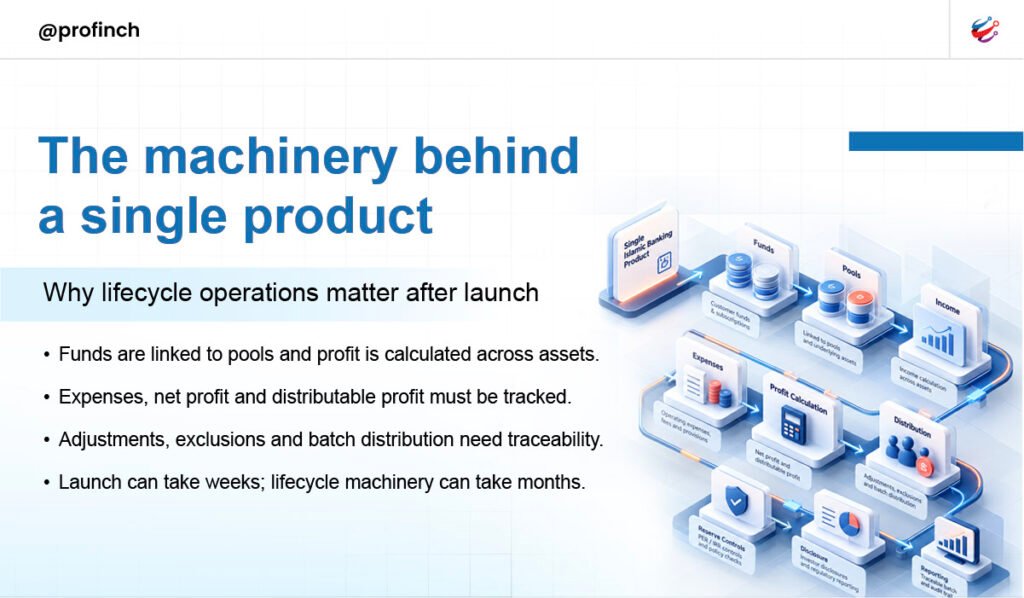
Consider what sits behind a Mudarabah deposit once it is live. Funds are created and linked to pools. Income is calculated on the assets the pool finances. Attributable expenses are adjusted, net profit is derived and distributable profit is calculated. Manual adjustments and process exclusions are applied. Distribution then runs as a batch across account categories and weightages. Each step has a rule, an owner and, increasingly, a disclosure.
The UAE central bank’s 2022 standard on profit equalisation illustrates how much of this regulators now expect to see. Banks must set limits on transfers to the profit equalisation reserve (PER) and investment risk reserve (IRR) and “distribute the rest”. They must maintain a methodology to identify, monitor, measure and report displaced commercial risk. They must disclose the mudarib share for the current and at least two previous periods, together with the actual profit distributed to each category of investment account over the last two years. That disclosure can only be produced if every stage of the distribution batch is traceable11. Saudi Arabia’s rules on profit-sharing investment accounts raise similar questions of segregation and reporting.
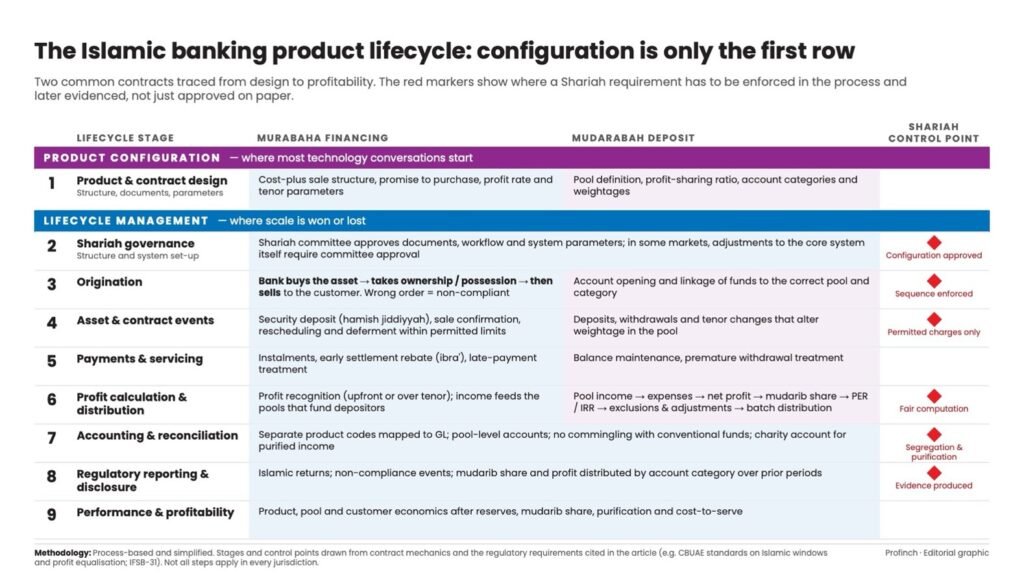
Murabaha financing has its own tail: the security deposit (hamish jiddiyyah), sale confirmation, the choice between upfront and deferred profit recognition, rebates on early settlement, and rescheduling or deferment, each constrained by rules about what can and cannot be charged.
Implementation experience makes the gap between launch and lifecycle concrete. At one greenfield Islamic bank in an emerging African market, the first phase (customers, current and savings accounts, Mudarabah deposits, Murabaha financing, the general ledger and teller operations) went live in 22 days. The second phase, covering trade finance, treasury and Islamic money markets, Islamic letters of credit, Islamic fixed assets, limits and collateral, and profit distribution, was planned over 18 weeks. The products were live in weeks. The machinery that lets them run properly took months.
Configuration creates products. Lifecycle management creates scale.
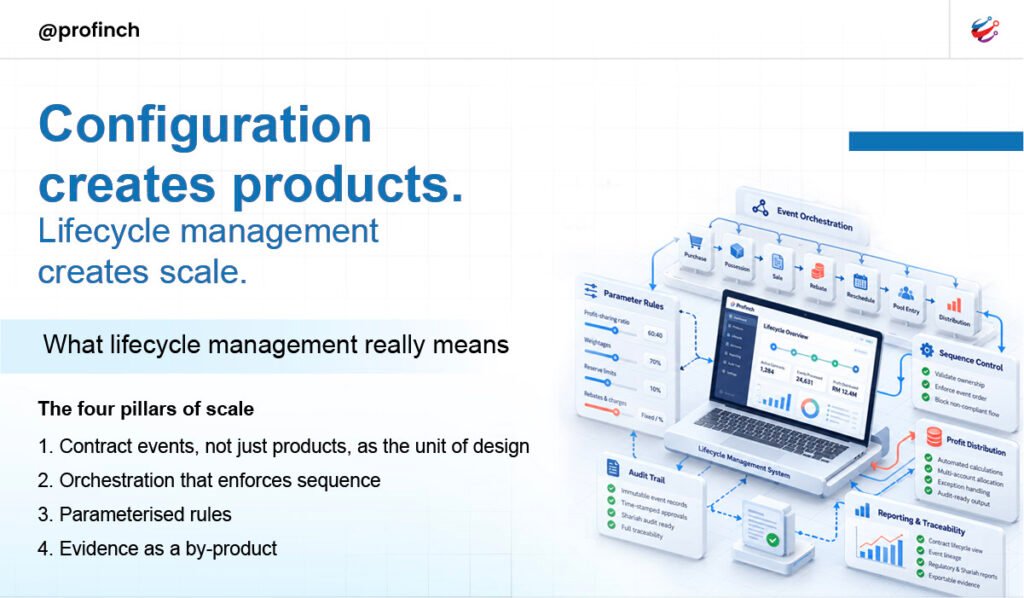
In practice, lifecycle management means four things:
- Contract events, not just products, as the unit of design. Purchase, possession, sale, rebate, reschedule, pool entry and distribution are each events with Shariah significance.
- Orchestration that enforces sequence. The system should make it impossible, not merely discouraged, to sell before owning.
- Parameterised rules for profit-sharing ratios, weightages, reserve limits, rebates and charges, so that a policy change is a controlled parameter change rather than a code change.
- Evidence as a by-product. Every step leaves a record that a Shariah auditor or supervisor can follow without reconstructing it by hand.
The questions a leadership team should be asking change accordingly. How many manual interventions does a month-end profit distribution need? How long would it take to change a profit-sharing ratio across every affected account and prove that it was done correctly? How much of Shariah audit is spent reconstructing evidence rather than reviewing it?
Shariah governance is moving into the operating architecture
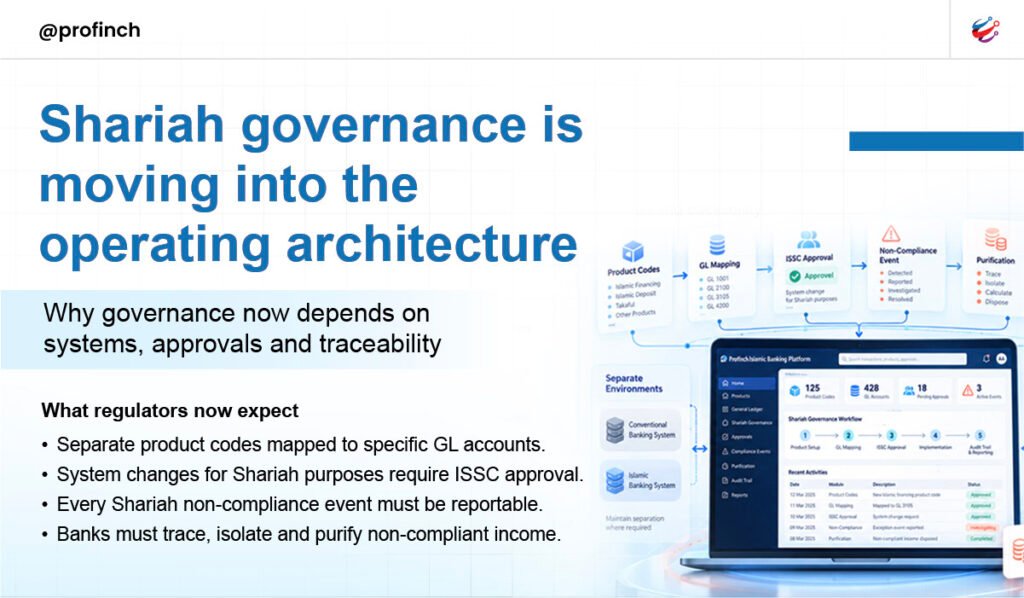
For many banks, Shariah governance has worked as a review layer above operations. Regulators are pushing it downwards, into systems.
The UAE central bank’s standard for institutions with Islamic windows requires separate product codes for Shariah-compliant products “mapped with specific General Ledger accounts”. It allows a single or dual core banking system, but where a single system is used, the adjustments made to it for Shariah purposes “must be approved by the ISSC”, the internal Shariah supervisory committee12. In other words, core banking configuration has become a Shariah governance event. The IFSB’s July 2025 principles on supervising Shariah governance (IFSB-31) go further on data: supervisors should expect every Shariah non-compliance event to be reported to them “irrespective of materiality”13.
Bank Islam Malaysia reported Shariah non-compliant income of RM41,619.70 from two non-compliance events in 2024, which was disposed of to charitable causes with its Shariah committee’s approval14. The amount is immaterial. The capability to produce it is not: tracing income back to the specific event that made it non-compliant, then isolating and purifying it.
Implementation experience spans both models these rules allow: Islamic and conventional books on separate environments, and single platforms carrying Islamic templates across accounts, financing, money markets and trade finance, including interest-free banking windows run alongside conventional operations. Either can work. What does not work is a platform where nobody can show what was changed, when, and under whose approval.
Governance maturity has therefore become a question of how quickly the bank can change. If every rule change needs Shariah approval and the system cannot evidence it, change cycles lengthen.
Standardise the machinery, localise the rules
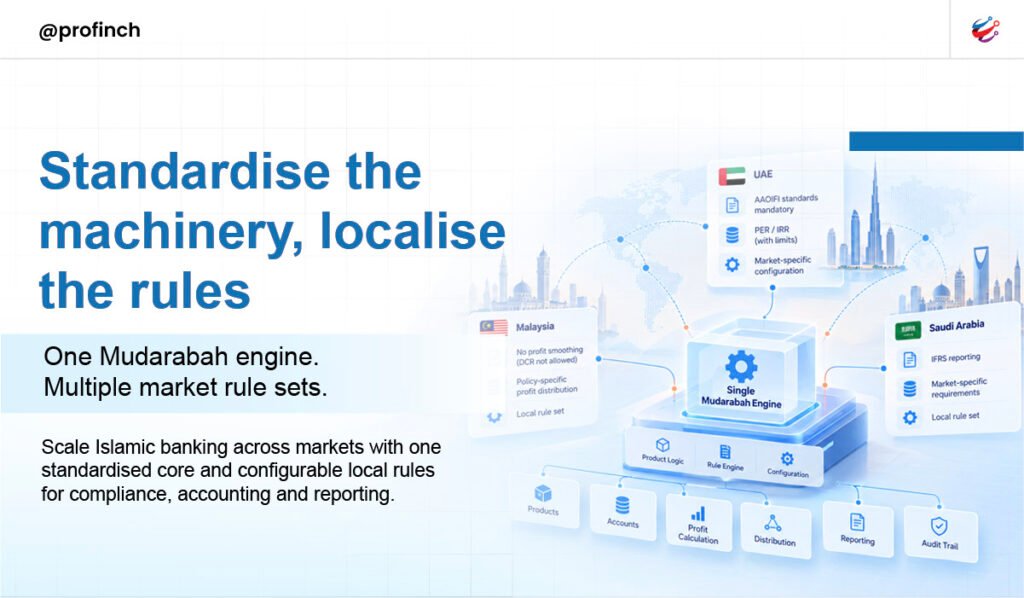
For banks operating in more than one market, the most Islamic-specific strategic question is how much to standardise.
The rules diverge at a level that matters to systems. The UAE’s Higher Sharia Authority has made AAOIFI Shariah standards mandatory15, and Oman requires AAOIFI accounting standards16, while Saudi Islamic banks report under IFRS17. On profit smoothing, the divergence is sharper still. The UAE standard permits PER and IRR within set limits. Bank Negara Malaysia’s policy document on investment accounts states that institutions “must not implement profit smoothing practices or displaced commercial risk (DCR) techniques”18. The same kind of product therefore needs opposite rules in two markets.
The rule set is also changing. AAOIFI’s FAS 45, 46 and 47, covering quasi-equity including investment accounts, off-balance-sheet assets under management and transfers between investment pools, apply to financial periods beginning on or after 1 January 2026, as disclosed in the financial statements of institutions that report under AAOIFI19. Further standards on participatory ventures and on Salam and Istisna follow in 2027. And in November 2025, AAOIFI’s secretary-general said its draft Shariah Standard 62 on sukuk ownership transfer had been put on hold for further consultation20.
The architectural implication is clear. A bank in three markets should be running one Mudarabah engine with three rule sets, not three engines. Standardising the machinery and localising the rules is what keeps market expansion from turning into a system rebuild.
Regulatory reporting and profitability: the missing visibility layer
The value chain that matters to management runs from transaction to operations to accounting, then to reporting, profitability and decision. In Islamic banking, that chain has more breaks in it than usual, because a product’s economics are spread across places that conventional reporting keeps apart: profit recognised contract by contract, pool income allocated across account categories, the mudarib share, reserve appropriations, hibah and purified income. To know whether a Mudarabah savings proposition actually makes money after cost-to-serve, a bank has to connect pool accounting to products and to customers.
Supervisors are asking for the same connection. The IMF’s Core Principles for Islamic Finance Regulation expect “effective information systems for accurate and timely identification, aggregation, monitoring, and reporting” of rate-of-return exposure to boards and senior management21. Reporting estates are already large before Islamic products arrive. In one Central Asian implementation, the central bank’s reporting set alone ran to close to 30 returns, several in more than one variant. Newly legislated Islamic finance markets will need Islamic books to flow into estates like this without rebuilding them.
Management can often see growth without seeing the economics of growth. And a bank cannot systematically retire complexity it cannot measure.
What Islamic banking technology architecture needs to do differently
The requirement is not more technology but architecture that makes specific things possible.
What the architecture must do
The Islamic banking reason
The executive consequence if it doesn’t
Orchestrate contract events in order
Murabaha ownership must precede sale; missing or out-of-order steps create non-compliance
Income at risk of purification; audit findings
Run a parameterised profit engine
Pools, weightages, mudarib share and reserve limits vary by product and market
Month-end spreadsheets; cost and control burden
Separate product logic from jurisdiction rules
AAOIFI versus local standards; smoothing permitted in one market, prohibited in another
Each new market becomes a rebuild; slower expansion
Keep an auditable record of configuration changes
Shariah committees may need to approve system adjustments
Longer change cycles; governance risk
Hold data at event level, with lineage
Supervisors want all non-compliance events reported and distributions disclosed
Compliance hard to evidence; weaker supervisory confidence
Build window segregation into the design
Separate product codes, GL mapping and no commingling
Sanctions: in June 2025 the UAE central bank fined one bank’s Islamic window AED 3.5 million and suspended new onboarding for six months22
Unify finance and profitability data
Income, reserves and purification sit in different ledgers
Product economics invisible; poor capital allocation
Modernisation, on this view, should be measured not only by how much technology is introduced but also by how much complexity is removed. A new platform that inherits fragmented profit processes and inconsistent data may modernise the bank without simplifying it.
The executive question is changing
The question that shaped the last generation of Islamic banking technology was: can we launch this product?
The question that matters now is harder: can we run this product’s full economic, operational, Shariah governance and reporting lifecycle in every market we operate in, change it safely, and prove at any point that it was done correctly?
That question belongs to the COO, CFO and Shariah committee as much as to the CIO.
Conclusion: the lifecycle is where the promise is kept
The direction of travel is visible in the evidence. Constitutional deadlines, as in Pakistan, are driving conversion at system scale. New frameworks in Central Asia are bringing Islamic books into banking systems built for conventional ones. IFSB-31 is recommended for implementation by January 2027. AAOIFI’s new standards on investment accounts and pools are already in force, with more to come in 2027. None of these is a product launch. Each changes the machinery behind products that already exist.
That points to a different basis for advantage. The Islamic banks best placed for the next phase are likely to be those that absorb rule changes, new markets and new structures by changing parameters rather than systems, and can show their Shariah committee, supervisor and management exactly how every contract was run.
In Islamic banking, the product is the promise. The lifecycle is where that promise is kept.

Profinch works with Islamic banks and banks with Islamic windows across core banking, transaction banking, payments, digital channels, data and regulatory reporting. If you are assessing how well your architecture handles profit distribution, Shariah controls or multi-market rules, speak to our team or explore our client case studies
References
Available on request.